LIAISON JOB BASED ON DODGY EMAIL REVIEW
 GINGIN will employ a liaison officer to cope with “a significant increase in the volume and complexity” of councillors’ requests for information it claims posed psychosocial risks for staff at the shire.
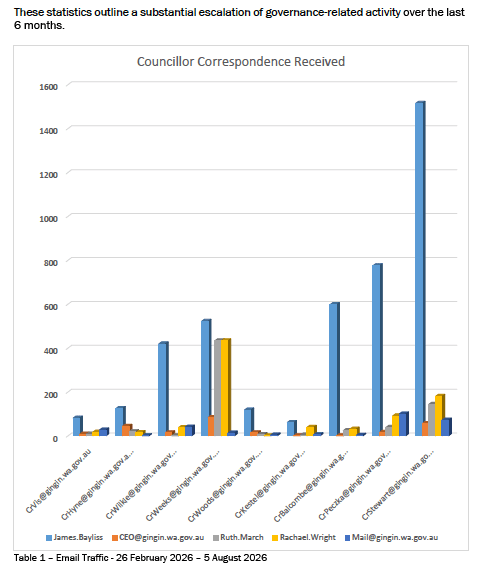
The acting CEO’s recommendation passed on August 18 with 13 staff in the chamber including six councillors (one overseas) was based on a review of members’ emails from February 26 to August 5.
The reporting period covers the shire’s former executive manager of regulatory and development services James Bayliss’s time as acting CEO. His predecessor Scott Wildgoose was suspended in February and resigned in May after findings of sexual misconduct at the wheatbelt shire (https://www.streetwisemedia.com.au/workplace-incident-swept-under-carpet/).
Appointed by WA’s Local Government Inspector, Gingin monitor Shayne Silcox sat through four hours of heated debate and bickering until the meeting was closed at 7pm. Mr Silcox sitting in the public gallery then signalled President Linda Balcombe that he wanted to speak to councillors and staff.
Several agenda items and motions including 11 breaches remained unresolved even after the meeting was extended for an hour. Deputations before the meeting with presentations by four speakers including on coastal erosion at Lancelin started at 2pm and ended at 2.36pm so members of the public had to wait until council convened at 3pm.
 The acting CEO’s email review includes elected members’ questions, notices of motion, requests for information, confidential briefings, external agency referrals, multiple special council meetings and high volume of complaints since Mr Bayliss assumed the acting CEO role.
StreetWise understands Mr Bayliss has been on sick leave at least twice since February.
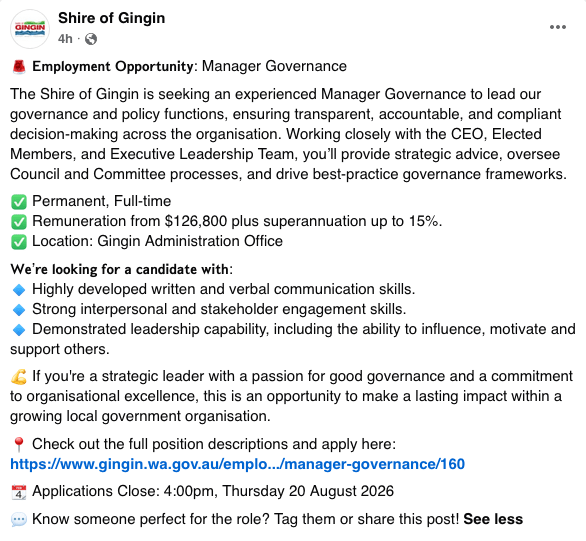 The shire already has a communications officer and a governance officer. It also has advertised for a governance manager.
“The preparation of responses frequently requires input from multiple business units, legal and governance review, document retrieval, coordination of confidential information, and considerable executive oversight. This work is often undertaken within compressed timeframes and in addition to the organisation’s normal operational responsibilities. The sustained level of governance demand has also increased psychosocial risks within the workplace. Staff have experienced prolonged periods of high workload, repeated interruptions to planned work, compressed deadlines, interruptions to leave and ongoing exposure to contentious governance matters.”
The officer’s report also states the increased workload, “impacted the organisation’s ability to respond within the time required to the coastal erosion response in Lancelin”. Cr Balcombe was overseas on holiday and Mr Bayliss was on leave during the Lancelin crisis.
It said: “The establishment of a dedicated council liaison position is therefore not proposed as an enhancement to existing service levels, but as a necessary organisational response to the level of governance activity currently being experienced as a result of council-related demands.”
 To justify the new liaison position, findings were presented by Integrated ICT which anaylsed members’ email traffic since February 26 when council suspended Mr Wildgoose: “Cr Stewart has lodged 66 of the questions on notice by a member and 30 ‘additional questions’ immediately prior to consideration of the 26/27 budget. Cr Wilkie has lodged 22 of the questions on notice referenced. This accounts for all of the questions on notice by a member. Cr Stewart has lodged 14 notices of motion and Cr Wilkie has lodged four notices of motion, accounting for the entirety of this statistic. While behavioural complaints are confidential, the data shows a sharp increase in the volume of complaints over the past six months.”
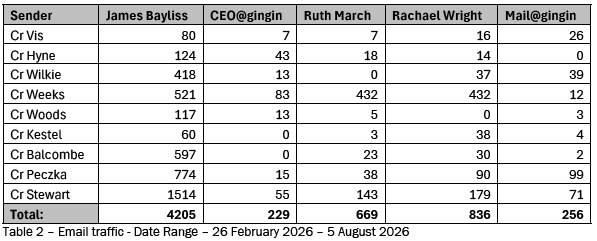
The table shows the number of emails elected members sent to the shire including Mr Bayliss, operations & assets executive manager Ruth March and corporate & community services executive manager Rachael Wright, who is on sick leave and expected to take up her new role as CEO at the shire of Boddington on October 13.
The email table does not show how many emails Mr Bayliss’s office responded to nor whether it was higher or lower than in previous months or just under the acting CEO’s watch. Email responses would indicate the level of resources Mr Bayliss claims are increasingly being spent on complaints and governance issues during his short tenure.
Mr Silcox’s view on the matter also would be helpful unless it is beyond the monitor’s ‘prime directive’ not to interfere, but to observe and report only to the local government inspector.
 According to the officer’s table, Cr Stewart since February supposedly sent a total of 1962 emails or nearly 400 emails per month to the CEO’s office. The figures are grossly inflated and misleading as they contain no context, content or subject in emails sent and/or shared with the shire and other councillors.
Cr Weeks strongly disputed the figures. The table shows he sent 432 emails equally to Ms March and Ms Wright. He told council he sent only four emails to Ms March and about 13 to Ms Wright, and only because Ms Wright was the public interest disclosure officer to whom members can report issues of concern.
In Cr Stewart’s case, the higher number of emails could reflect his role as deputy president of WALGA’s Avon-Midland local government zone consisting of 13 councils and member of the Moora regional roads group. All correspondence including public communications and complaints are regularly shared with staff and elected members.
Councillors disputing the figures have sought legal advice.
Gingin overloaded
GINGIN flagged its concerns over ‘significant psychosocial risks’ at the shire on August 6 when it raised concerns on its social media page over, “the nature and volume of public commentary”. (https://www.streetwisemedia.com.au/gingin-shire-pulls-mental-health-card-to-cover-dysfunction/).
It acknowledged the community’s right to express views, ask questions and hold local government accountable, “However, recent commentary across social media platforms and some media outlets has escalated to a point where staff are being personally targeted. In many instances, information being circulated is inaccurate, misleading or unverified, and the cumulative impact of this commentary is creating significant psychosocial risks within the workplace”.
 Neither its social media announcement or officer’s report presented last week detail what resources the shire increasingly spent to address inaccurate claims and manage the, “impacts of ongoing public criticism”.
How many media requests did the shire receive? Importantly, how has misleading and unverified’ commentary created significant psychosocial risks? How many staff have been ‘personally targeted’?
The shire despite repeated requests has never offered information or proper answers to questions over various issues the free online publication has covered exclusively since the start of 2026. Even Gingin’s communications officer has stopped responding.
Gingin resident Megan Kolbe asked the acting CEO to provide actual staff-hours analysis used to convert the email, questions on notice, notices of motion, complaints and meeting statistics into a demonstrated requirement for one additional full-time employee.
“The research is flawed and incomplete,” Ms Kolbe told StreetWise. “If there is no analysis, what quantitative basis is there for supporting the employment of new staff.”
Ms Kolbe said email volume is fundamentally “a traffic measurement”. She said unless the analysis actually examines the contents and staff time required for each email, a high number of emails does not automatically equal the same number of substantive pieces of work.
“Email counts are evidence that communications increased, but they aren’t by themselves a workload study.”
She said there is no information on the staff hours attributable to different categories of emails, comparison with previous years, how many questions could be answered from existing records, duplication rates, complexity of requests, actual overtime/additional expenditure, and evidence showing why existing governance resources cannot absorb the workload.
“It proves there has been a large increase in councillor-driven governance activity. It does not, prove that the activity is excessive, unreasonable or that one additional full-time position is necessarily the appropriate response.”
 Ms Kolbe added: “There is no supporting appendix. Councillors therefore aren’t given the underlying ICT report in this agenda to independently examine its methodology.”
She said her interpretation of the data in the past six months is that some councillors are communicating and working a lot harder than other councillors.
It also reflects as Mr Silcox can see firsthand Mr Bayliss’s ability having never worked as a CEO to manage the shire and its assets until a new CEO is appointed.
Until then, questions remain over a number of serious governance and administrative issues covered exclusively by StreetWise including the secret report that led to Mr Wildgoose’s resignation (https://www.streetwisemedia.com.au/workplace-incident-swept-under-carpet/) and shire’s ‘misplacement’ of more than 1.5 million litres of water from a council house occupied by Ms Wright who remained in the chamber when the issue was raised at council; (https://www.streetwisemedia.com.au/wheatbelt-shire-misplaces-hay-prime-jarrah-1-5-million-litres-of-water/).
The officer’s report warned without an extra pair of hands the shire would have to stretch resources, delay the time responding to elected member requests, governance matters and operational functions due to competing priorities, increase the risk of staff fatigue, burnout and staff turnover; and “reputational damage via the diversion from core functions”.
The vote was 4-4, Cr Balcombe using her casting vote to pass the officer’s recommendation.
Additional reports www.streetwisemedia.com.au.