

GINGIN SHIRE CONSIDERS RISKY SOCIAL MEDIA POLICY
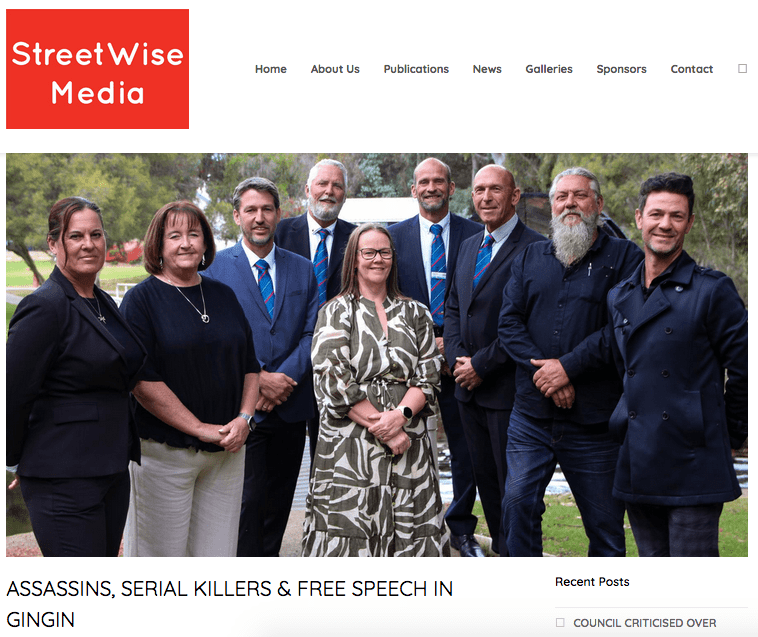 NEWS FEATURE: They are a highly sensitive lot at Gingin shire when it comes to the use of social media by elected members.
Tonight, the wheatbelt council will vote on a proposed, more prescriptive policy flagged at its March 17 meeting when acting CEO James Bayliss recommended an independent investigation to identify the administrator(s) of ‘Voices of Gingin’ and a new policy to avoid, “negative and disparaging public commentary”. (‘Assassins, serial killers & free speech in Gingin’, March 16).
Voices of Gingin was formerly called ‘Gingin Ratepayer Collective’ administered by Gingin councillors Lincoln Stewart and David Wilkie, who left the page in 2023 when they decided to run for council.
The March item followed two motions presented to the annual general meeting of electors on February 3 by Bendigo board members (and electors) Wendy Harris and Stephen Beckwith who noted it was disappointing ‘internal challenges’ of council were aired publicly and that the community did not benefit from councillors commenting on legal matters, how council voted or conducted themselves at council meetings.
“The behaviour risks normalising a toxic culture, discouraging capable future candidates from standing for council and exposing the shire to reputational and governance risk.”
Harris and Beckwith effectively were asking for the publication of names and personal information about clients of their own bank including Gingin Ratepayers Collective, likely breaching their own bank’s code of conduct? They also singled out Cr Stewart.
Officers said there is a risk to council if Harris and Beckwith’s motions were not supported by elected members, “given the view in the community that councillor comments online are undermining community trust in the shire”.
In this case, councillors under local government rules must declare an interest in any Bendigo-related item. Shire president Linda Balcombe is Bendigo board’s executive officer and after declaring an impartiality interest voted on both motions on March 17 with Cr Robert Kestel, a non-executive director at the community bank. Cr Craig Hyne’s daughter also works at Bendigo (‘Our bank, our thing in Gingin’, March 22).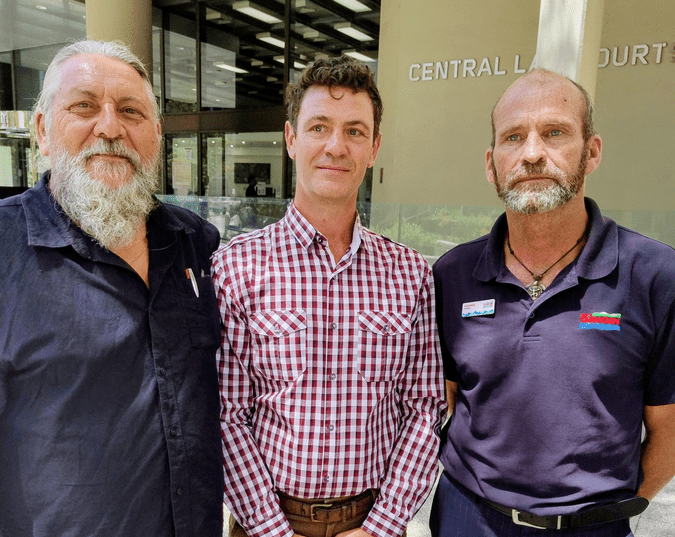
Cr Andrea Vis did not attend, so Cr Balcombe as presiding officer used her casting vote to pass the Voices motion. The second proposed motion was passed 5/3. Crs Stewart, Weeks and Wilkie voted against.
Mr Bayliss said: “There could be a perception the shire is interfering with freedom of speech and a separate community engagement forum if the motion is supported. However, if the motion is not supported then it potentially creates a reputational risk if people believe the shire is apathetic to the conduct of the page.”
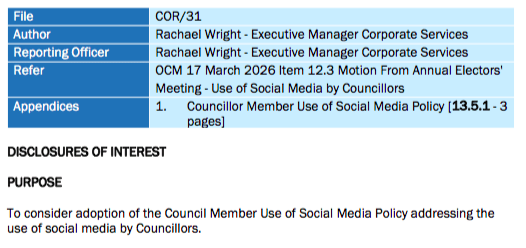
In tonight’s agenda, executive manager corporate services Rachael Wright states it sought feedback from WALGA which, “considers the Code an appropriate guideline relating to social media use”, noting, “its strategic nature limits the level of detail that a separate policy can more effectively provide”.
Under the proposed policy, council members, “must not post, support items (for example ‘liking’ them) or comment in ways that could reasonably be perceived as bringing the shire into disrepute or undermining public confidence in the shire”.
Council members also must speak with ‘one voice’ and recognise their public comments may create, “psychosocial risks to employees regardless of the platform used or stated personal intent, and they have a responsibility to ensure this does not occur”.
 Council decisions must be supported publicly (even if they vote against items) and councillors must never, “Criticise, ridicule or make adverse reflections on shire employees, their work or the CEO/administration in ways that could damage morale or psychosocial safety (e.g., public complaints about ‘poor service’, staff ‘incompetence’, or administrative delays)”.
StreetWise contacted the shire and asked whether it would also investigate two other now defunct sites ‘John Booth’ and ‘Ed Gein’ where the mayor, councillors and members of the public disparaged and threatened Cr Stewart. The proposed investigation does not extend to such sites, one of which StreetWise understands was established by the shire president’s husband Steve Balcombe.
‘Public ventilation’
 GINGIN councillors would be well served to read a State Administrative Tribunal review decision involving Subiaco Cr Julie Matheson over the use of the word ‘paranoia’ in a letter published by the Subiaco Post in 2018.
Having criticised a council decision to exclude the public from discussions of an agenda item concerning a planning matter, Cr Matheson was reported for a minor breach of local government regulations.
“The parties accept that a councillor has a two-pronged duty towards the public. Although courtesy and respect are essential in the interaction with fellow councillors, it is also accepted that public office and public interest require robust debate, public ventilation of differences and scrutiny of policies. Respecting decisions of a Council does not equate with necessarily agreeing with the merit of those decisions. Even after a vote on a matter had been taken, a councillor could explain to his or her electorate why he or she disagreed and continues to disagree with that decision; that is a part of the usual democratic processes.”
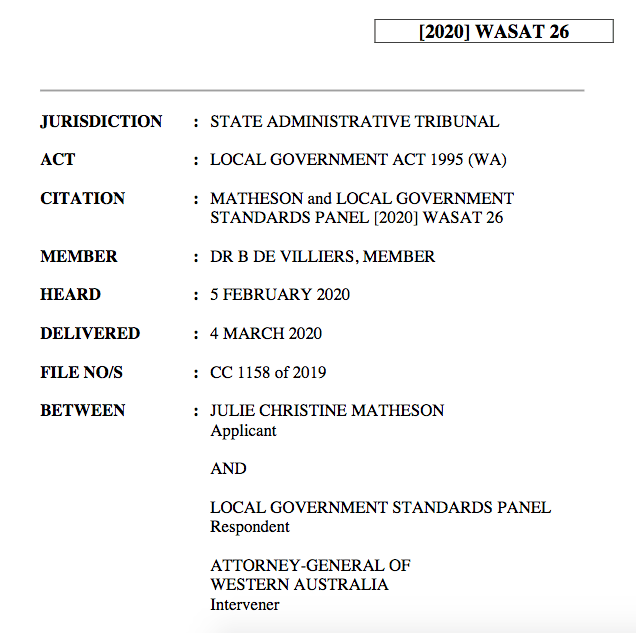 SAT found elected members can publicly explain any disagreement with council decisions and that respecting council decisions did not equate with agreeing with the merit of its decisions.
It said it was satisfied the duty of the applicant towards her office, towards fellow councillors and towards the public, justified bringing to the attention of the public, her concern that the public may have been excluded from the meeting without a proper legal basis.
“This is a reasonable concern arising from the importance of accountability and responsibility,” it said, adding her actions were, “reasonable, proportionate and consistent with what could be expected of a prudent councillor after she had exhausted all other avenues”.
When asked by SAT why she wrote the letter and aired her criticisms publicly, Cr Matheson said she had no other avenue left to bring to light her concerns which had been ignored by the CEO, mayor and majority of council: “In her view, the Council is ultimately responsible and accountable to the public and the public had the right to know that they had been excluded from a meeting without a proper legal base for that decision.”
The tribunal was satisfied Cr Matheson had exhausted all options and that she owed a duty to the public to make them aware the decision to exclude them may not have been proper in accordance with the the Act and, “the option to publish a very succinct letter in the Post newspaper was reasonable. The applicant acted in the best interests of the Council and in accordance with her obligation of fidelity to the Council”.
It added: “The standard of conduct by the applicant was not inconsistent with what would be expected of a person in the position of the councillor by reasonable persons with knowledge of the duties, powers and authority of the councillor and circumstances of the case.”
Retired lawyer Mike Cramb has described the second motion as, “a deeply troubling development”. He posted on March 20: “Local government exists to serve the public, not to curate, sanitise or monopolise public discourse, who may express them, or how robustly they may be stated. Nor is it the role of elected officials to insulate themselves, or others, from criticism simply because that criticism may be uncomfortable. Democracy is not a feelings-management exercise”.
He said the proper response to strong public debate is not to narrow the channel of communication, but to widen it: “When debate is centralised in a single office-holder, the public is entitled to ask: ‘What is being protected – clarity or control?’”
Additional stories www.streetwisemedia.com.au.


